
How Do Organisations Clean Up After Corruption Scandals?

blatter4

Transparency International
July 24, 2015

by Roger Pielke, Jr.

Hisao Tanaka, president of Toshiba Corporation, and two top executives resigned after an independent investigation found that earnings had been improperly inflated by US$1.2 billion under his watch.

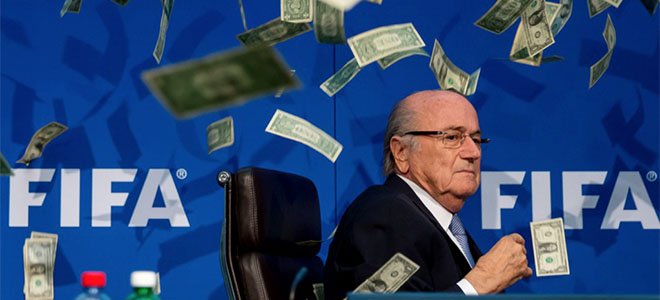
Simultaneously, FIFA’s president Sepp Blatter announced that he was staying on for another seven months, despite the arrest of numerous top FIFA officials and widespread corruption on his watch. FIFA appears to be looking to Domenico Scala, who is on the FIFA payroll, to lead a new reform effort.

The vastly different approaches to investigation by Toshiba and FIFA help to illustrate the difference between an accountable organisation and one that plays by its own rules. Here is a recap of what Toshiba did leading up to the leadership resignations:

Upon learning of possible wrongdoing, Toshiba set up a “Special Investigation Committee” chaired by the chair of its board of directors. This committee included experts from outside Toshiba.

Upon learning of the scope of possible wrongdoing, this is what Toshiba did (more details here):

In order to further enhance the confidence of stakeholders in the results of the investigation, the company has decided to change the framework of the investigation from one conducted by the current Special Investigation Committee to one conducted by an Independent Investigation Committee that conforms to the guidelines prescribed by the Japan Federation of Bar Associations (JFBA) by being composed solely of fair and impartial outside experts who do not have any interests in the company.

How were the members of the Independent Investigation Committee chosen?

The members of the Independent Investigation Committee are currently being selected from among experts in the fields of law and accounting, based on the recommendations of the outside members of the Special Investigation Committee, and the company plans to promptly disclose the composition of the Independent Investigation Committee (IIC) once the selection process has been concluded. Read more …


Posted in New Publications | Leave a comment

If We Discover Extraterrestrial Life, What Happens Next?

wow

The Guardian
July 23, 2015

by Roger Pielke, Jr.

The search for extraterrestrial life is seen as one of pure curiosity. But, as in other areas of science, we should worry about the consequences of success.

Fifty years ago the era of robotic exploration of our solar system was just beginning. In July 1965 the Mariner IV probe sent back data showing that Mars did not have vegetation, much less canals crisscrossing the planet as envisioned by earlier generations of astronomers. The New York Times opined that Mars was “The Dead Planet” with the chances for life of any kind to be “infinitesimal.”

Carl Sagan, astronomer and early rock star scientist, asked why the media was so quick to “deduce a lifeless Mars?” The answer, he wrote, was a sense of “relief.” He posited that “finding life beyond Earth – particularly intelligent life … wrenches at our secret hope that Man is the pinnacle of Creation.” The meaning of the possible discovery of extraterrestrial life Sagan concluded is “many things to many men.”

Earlier this week Stephen Hawking, theoretical physicist and modern rock star scientist, along with Russian billionaire Yuri Milner announced that they would be launching a new project to boost efforts to look for intelligent life outside our solar system. Milner, who is funding the effort, said that he had been “thinking about this since I was a child, reading Carl Sagan’s book.”

Upon hearing of the new project, called Breakthrough Listen, I was reminded, of all things, of a recent prison break. Last month two convicted murders escaped from a New York prison. They had spent months carefully planning and executing their escape, which involved cutting and digging their way through walls, pipes and concrete. Remarkably, however, the pair gave little thought to what they would do if they actually succeeded in their plans. The consequence of the lack of planning was a short effort to flee from authorities followed by the death of one prisoner and re-capture of the other by authorities.

The search for extra-terrestrial life shares some similarities. We are investing considerable attention and resources into the search, but little into thinking about the consequences of success. As Carl Sagan imagined, it is as if we expect to fail, which would be a relief. Even Milner says, “It’s quite likely that we won’t find anything.” But what if we do succeed? What then?

Let’s face it, talking about aliens can be seen as a little weird, even in academia, where we study all manner of weird things. A search of Google scholar for “extraterrestrial life” returns only 15,100 hits, the vast majority of which are about “search.” In contrast, “genetically modified” returns more than 800,000, “nanotechnology” almost 900,000 and “climate change” more than 1.6 million.

Assessing technologies and their implications for society is clearly important, but it seems that we have a bit of a blind spot when it comes to the possibility of success of projects like Breakthrough Listen. So, what should we be doing instead? Read more …

Posted in In the News, New Publications | Leave a comment

‘Sprinters Don’t Improve After 30. Gatlin’s Feats Are … Incredible’

sprinters

Sporting Intelligence
July 20, 2015

by Roger Pielke, Jr.

The fastest time in the 100m in 2015 so far belongs to Justin Gatlin, the American sprinter twice sanctioned for doping violations. That Gatlin has come back from suspension during 2006 to 2010 to become the top sprinter in the world today makes for a remarkable story. The fact that he is doing it at age 33, for some, makes the story a bit too good to be true.

At present, no one has outright accused Gatlin of achieving his current success by breaking the rules. But questions remain. Ross Tucker, an expert in athletic performance explained that “Gatlin is the problem that will not go away… he is a former doper, dominating a historically doped event, while running faster than his previously doped self.”

For his part, Galin is aware of the talk, saying: “There’s nothing I can do except go out there and keep running and pushing the envelope.”

I was curious about how unusual Gatlin’s performance is as a 33-year old. Now that I’m closer to 60 than I am to 30, I have a soft spot for the older athletes taking it to the youngsters, like 33-year old Serena Williams, who at Wimbledon this month won her 21st tennis Grand Slam singles title and doesn’t seem to be slowing down.

The first thing I did was to gather data from IAAF.org, which hosts a wonderful data repository, for the top nine sprinters ever at 100m, and compare how their times progressed as they aged. That data is shown in the chart below. (I added in Carl Lewis because I was curious.) Read more …

Posted in New Publications | Leave a comment

Analysis: U.S. Soccer Raises More Questions Than Answers in Senate Hearing

flynn

USA Today
July 17, 2015

by Roger Pielke, Jr.

The U.S. Senate did something Wednesday that it has never done before. No, not voting itself a pay cut. It held a hearing on the governance of soccer, and it raised disturbing questions about the federation that oversees the sport in this county, U.S. Soccer.

Congress gets a lot of criticism, much of it well-deserved. But on issues related to sports it actually has a strong, bipartisan track record of success. Whether it is steroids in baseball or athlete rights in the NCAA, Congress seems to be able to handle partisan differences and focus attention on what matters when it comes to sports. Wednesday’s hearing on FIFA, the Swiss-based organization that runs global soccer, was no different.

Soccer is becoming a thing in the United States. The U.S. women just won their third World Cup, and shattered viewership records along the way. The men’s team has its own record of successes in the World Cup and is currently trying to win its second consecutive Gold Cup tournament.

But as everyone knows, all is not well in the governance of the sport. In May, U.S. and Swiss governments collaborated in the arrest and indictment of 14 people associated with an investigation into corruption at the highest levels of the sport. Loretta Lynch, the U.S. attorney general, said that these arrests were only the beginning of a broad inquiry that has defrauded U.S. businesses and taxpayers.

Thus, it was no surprise when FIFA president Sepp Blatter declined an invitation to participate in Wednesday’s hearing. What was a surprise was that the president of the U.S. Soccer Federation, Sunil Gulati, also declined an invitation.

Instead, U.S. Soccer chief executive officer Dan Flynn represented the federation, claiming with a straight face to be more knowledgeable on the subject of the hearing than Gulati, who sits on the FIFA executive committee.

Flynn’s appearance before the committee was a disaster. At times evasive and others confused, Flynn even turned off his microphone at one point to consult with a colleague about how to answer a simple question.

U.S. Soccer are supposed to be the good guys in FIFA. Wednesday’s performance raised some doubts as to whether U.S. Soccer is really ready for the reform being forced by the Department of Justice.

When asked why U.S. Soccer hadn’t been more forceful to root out corruption, Flynn first pleaded ignorance – a stance hard to reconcile with years of media reports detailing FIFA’s corrupt practices. It’s also hard to reconcile when considering that the U.S. member of the FIFA Executive Committee, Chuck Blazer, lived in a swanky Trump Tower apartment in New York City, and kept a second one just for his cats. We now know that Blazer skimmed off tens of millions of dollars from soccer bodies, according to his guilty plea. Read more …

Posted in In the News, New Publications | Leave a comment

New eBook: Pielke’s Bridges Column 2005-2014

bridges

For 10 years, 2005-2014 Roger Pielke, Jr.  wrote a quarterly column for Bridges, a newsletter on science policy by the staff of the Office of Science & Technology at the Austrian embassy in Washington, DC.  All of Pielke’s columns have now been formatted into an eBook, which you can download free.

Pielke, Jr., R. A. (2015). Pielke’s Perspective: A Collection of Articles from Bridges, OST’s Publication on Science & Technology Policy., 93 pp., Center for Science and Technology Policy Research, Published July. (PDF)

Posted in New Publications | Leave a comment

Learning Processes, Public and Stakeholder Engagement: Analyzing Responses to Colorado’s Extreme Flood Events of 2013

flood7

Urban Climate
July 14, 2015

by Elizabeth A. Albright and Deserai A. Crow

Abstract: In early fall of 2013 in the Front Range of Colorado, several communities experienced intense rainfall over a three-day period, exceeding annual average precipitation rates. Extensive damage occurred to roads, infrastructure, parks, river corridors, homes and business throughout the region. Across the U.S. and in other nations, as population increases in flood-prone areas, flood risks and vulnerability are increasing as well. Successful response to extreme events may be due to policy learning—changes of beliefs, attitudes, behaviors, and goals – in response to new information and experiences. This learning can at times lead to adaptation of local policies to increase the resilience of communities faced with risk from extreme events. The extent of policy learning may depend on how communities engage with stakeholders and the public in post-disaster recovery. Using a comparative in-depth case study approach of seven Colorado communities, this study examines how communities actively engage stakeholders and the public in decision processes after an extreme event. Read more …

Posted in New Publications | Leave a comment

Wildfire Outreach and Citizen Entrepreneurs in the Wildland–Urban Interface: A Cross-Case Analysis in Colorado

fire2

by Elizabeth Koebele, Deserai A. Crow, Lydia A. Lawhon, Adrianne Kroepsch, Rebecca Schild & Katherine Clifford
Society & Natural Resources
July 13, 2015

Abstract: Due to rapid growth in the wildland-urban interface (WUI), the risk to lives and property from wildfires is increasing in the western United States. While previous studies have identified factors that influence residents’ perceptions of wildfire risk and responsibility for mitigation, less research has been conducted on how mitigation information is disseminated to residents or the most effective strategies for doing so. During an examination of two case studies of catastrophic wildfires in Colorado, an important actor involved in wildfire outreach emerged that we label the citizen entrepreneur. Citizen entrepreneurs are highly motivated community members who can help resource-constrained wildfire agencies encourage mitigation on private property by directly engaging with WUI residents. Using data from interviews with wildfire professionals and focus groups with residents, this research note introduces the concept of citizen entrepreneurs and provides an initial examination of the important role they can play in wildfire outreach. Read more …

Posted in New Publications | Leave a comment

Updated Figures: Media and Climate Change Observatory (MeCCO)

graph14

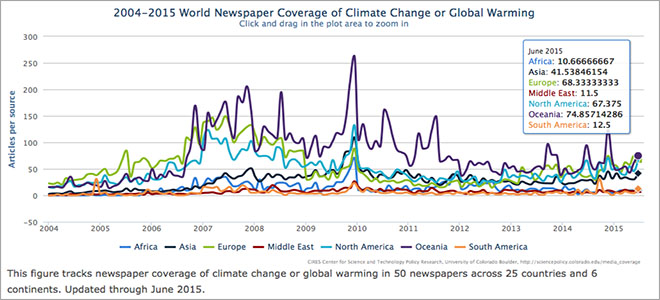
The Media and Climate Change Observatory (MECCO) monitors fifty sources across twenty-five countries in seven different regions around the world. MECCO assembles the data by accessing archives through the Lexis Nexis, Proquest and Factiva databases via the University of Colorado libraries. These fifty sources are selected through a decision processes involving weighting of three main factors:

  • geographical diversity (favoring a greater geographical range)
  • circulation (favoring higher circulating publications
  • reliable access to archives over time (favoring those accessible consistently for longer periods of time)

World, Australia, Canada, India, New Zealand, Spain, United Kingdom, & United States (Updated through June 2015)

Figure Citations

Nacu-Schmidt, A., Wang, X., Andrews, K., Boykoff, M., Daly, M., and Gifford, L., Luedecke, G., and McAllister, L. (2015). World Newspaper Coverage of Climate Change or Global Warming, 2004-2014. Center for Science and Technology Policy Research, Cooperative Institute for Research in Environmental Sciences, University of Colorado, Web. [Date of access.] http://sciencepolicy.colorado.edu/media_coverage.

Posted in Announcements | Leave a comment

New CIRES Center for Science and Technology Policy Research NSF Economics Project Recommended for Funding

cookstove

The National Science Foundation recently recommended for funding a new project at the CIRES Center for Science and Technology Policy Research (CSTPR) led by Research Scientist Katie Dickinson, along with co-PIs Zachary Brown (NC State), Michael Hannigan (CU-Boulder Engineering), and Abraham Oduro (Navrongo Health Research Centre).  The project, “Prices, Peers, and Perceptions: Field Experiments on Technology Adoption in the Context of Improved Cookstoves,” is described below.

Adoption of potentially welfare-improving technologies remains frustratingly low in many contexts. Improved cookstoves are a prime example: while cleaner-burning stove technologies have potential health, environmental, and social benefits, efforts to disseminate these technologies have fallen short and the practice of cooking with biomass over open fires remains dominant throughout much of the developing world. The central aim of this proposal is to study how economic incentives (“prices”), social learning (“peers”), and subjective beliefs (“perceptions”) interact to influence technology adoption dynamics. We do so through a field experiment in Northern Ghana that offers new stoves at different price levels to groups of households with and without social ties to households that have already received stoves as part of a prior NSF-funded study in this region: the REACCTING study (www.reaccting.com). Results will inform future efforts to disseminate clean cookstoves and other welfare-enhancing technologies beyond the study area.

Our conceptual model of households’ technology adoption and use decisions highlights multiple potential interactions among prices, peers, and perceptions.  Key research questions that will be addressed through our experiments include how price affects perceived quality of a new technology, how these perceptions are modified by exposure to peers that have experience with the technology, and how perceptions change over time based on one’s own experience and (objective and subjective) technology performance. We implement a novel identification strategy for identifying these effects, using the preexisting and exogenously controlled distribution of free stoves in combination with uncorrelated, cluster-randomized assignment to different stove subsidy levels. By explicitly measuring perceptions in conjunction with other outcome variables in the experiment (including both surveys and physical indicators of stove use and impacts on personal exposure to pollutants), the researchers will be able to test specific models about how prices and peers’ prior adoption interact in belief formation – a key issue in the technology adoption literature.

Posted in Announcements | Leave a comment

Is Science Policy a Theological Matter?

pope

by Roger Pielke, Jr.

The Guardian
June 23, 2015

With his latest statement on science, technology and the environment, Pope Francis has sought to change the debate on climate change. But his statement has broader significance for the way we think about the future

The Encyclical Letter Laudato Si’ released by Pope Francis last week has generated a wide range of reactions ranging from enthusiastic praise to uneasy criticism. For some, the Pope’s key message was about climate change, for others about the downsides of economic growth, and some saw in it a reconciliation of science and religion. But the Encyclical also lays bare a debate much larger than each of these perspectives, one that is fundamentally about what kind of world we want to inhabit. The Pope’s message is just the latest intervention in a debate over technologies that has been going on for centuries.

Pope Francis writes of the “human roots of the ecological crisis” defined in terms of deference to a “technocratic paradigm” which contains “the deepest roots of our present failures, which have to do with the direction, goals, meaning and social implications of technological and economic growth.”

The Pope’s choice of language is evocative of historian Lynn White, Jr.’s classic essay, “The Historic Roots of our Ecologic Crisis,” written almost 50 years ago in Science. White argued that technological innovation was a “realization of the Christian dogma of man’s transcendence of, and rightful mastery over, nature.” A consequence of this mastery, White suggested, is to “give mankind powers which, to judge by many of the ecologic effects, are out of control. If so, Christianity bears a huge burden of guilt.”

White’s proposed alternative to the dominant Christian narrative anticipated the Pope’s Encyclical: “we should ponder the greatest radical in Christian history since Christ: Saint Francis of Assisi” (from whom the Pope took his name). White continued: “the present increasing disruption of the global environment is the product of a dynamic technology and science which were originating in the Western medieval world against which Saint Francis was rebelling in so original a way. Their growth cannot be understood historically apart from distinctive attitudes toward nature which are deeply grounded in Christian dogma.”

What Lynn White was pointing to in the 1960s and Pope Francis writes of today can be viewed as a struggle over the meaning of humanity on planet Earth. What is our role? Do we dominate nature? Or are we of nature, even subservient to it? What kind of world do we want? What should we together value? Read more …

Posted in In the News, New Publications | Leave a comment